Home News Daniel Gryko Team Research Teaching Members Gallery  

History

     Gryko's research group has been formed informally in summer of 2000. Its beginning is strongly connected with so-called 'fast-track' - American style career development introduced by Prof. Mieczyslaw Makosza at the Institute of Organic Chemistry of the Polish Academy of Sciences. At the beginning the group consisted of just Daniel Gryko (30 years old at that time) and MSc-student Katarzyna Piechota (nee Jadach). The group research interest was strongly focused on the methodology of the corroles synthesis. The next MSc-student Mariusz Tasior began his experimental work in the group in December of 2001. Shortly afterwards (April 2002) Beata Koszarna has been accepted to became research assistant and subsequently (October 2002) first PhD-student in the group. The group continued to be focused on the chemistry of corroles and most of its major contributions in this area origin from this period. The next year two new PhD-students (Mariusz Tasior who in the meantime completed his MSc-Thesis and Michał Gałęzowski) were admitted. From this moment expansion of research interest has started to include also ferrocene-porphyrins and chlorins. The group has constituted of four people and this situation of certain stabilization continued for the next two years. The group began to be internationally known which in consequence resulted in international grants, invited lectures, exchange of researchers, organization of microsymposias as part of ICPPs etc.
     The next 'generation' of PhD-students started with Joanna Piechowska who started as research assistant in November of 2005. She became PhD-student one year later. The same year PhD-student from Ukraine Roman Voloshchuk started his career in the group. Miss Dagmara Wyrostek - student from Warsaw Technical University began experimental work in Gryko's group in 2005 and she completed her MSc-Thesis in December 2007. Also in 2005 Maciek Rogacki from Warsaw University has begun some work in the group and recently he became official MSc-student. The influx of new people has allowed for the further expansion of research interest to embrace other types of organic molecules with interesting spectroscopic and photophysical properties. In October 2006 Beata Koszarna defended her PhD-Thesis (with honors) and became first PhD promoted by Daniel Gryko. She then accepted position of senior research assistant (boss' 'right hand'). Marie-Curie Research Training Network Grant Funded by European Commission resulted in further internationalization of the research group and expansion of research interest to include also catalysis. First post-doc (Dr Cyril Rousseau, France) has spent only three months in the group (November 2006 - February 2007). Currently an another post-doctoral fellow Dr Ayfer Kalkan (Turkey) has started her work in the group. In October 2007 Olena Vakuliuk from Ukraine (also funded by EU) has started her PhD-study. The work of these two people is centered around application of porphyrinoid complexes (and other metal compounds) in catalytic oxidation. On 1st of January of 2007 Jan Lewtak has started as new PhD-student.
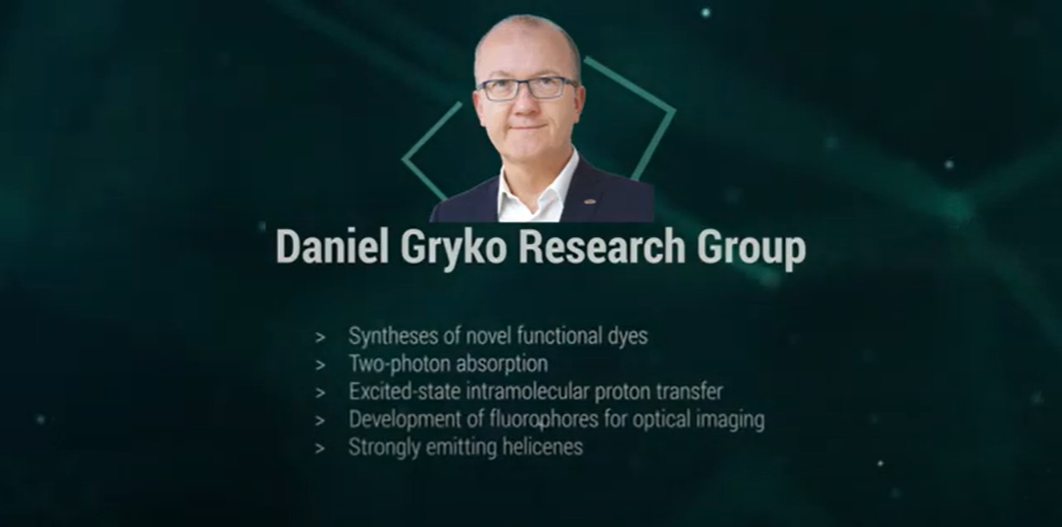
     In the first half of 2008 both Mariusz Tasior and Michał Gałęzowski defended their PhD-Theses and left to Ireland. In the following two years two new PhD-students joined the group (Jan Klajn and Agnieszka Nowak-Król). For the long time the research team consisted of 6 PhD-students (so called 2nd generation). Reaching the size of ~10 people Gryko's group started to produce ~10 publications/year. The subjects of research expanded to two-photon absorption and excited state intramolecular proton transfer. Especially this first subject proved to be fruitful. In 2010 the special grant (TEAM) from Foundation for Polish Science has been scored based on two-photon absorbing chromophores. It allowed to hire three post-docs and three PhD-students (3rd generation). Currently the group consists of nine PhD-students. However two of them already started to write their PhD-theses. In January 2010 Prof. Gryko started to work at Faculty of Chemistry of Warsaw University of Technology. In 2008 Prof. Gryko came up with idea of creating the European network centered around two-photon absorption phenomenon. After assembling the group of PIs submitted Marie Curie Research Training Network proposal. This proposal was eventually funded in June 2010. The whole multidisciplinary network TOPBIO (consisted of 8 research groups from 6 European countries and three companies) will start work on 1st December 2010.